

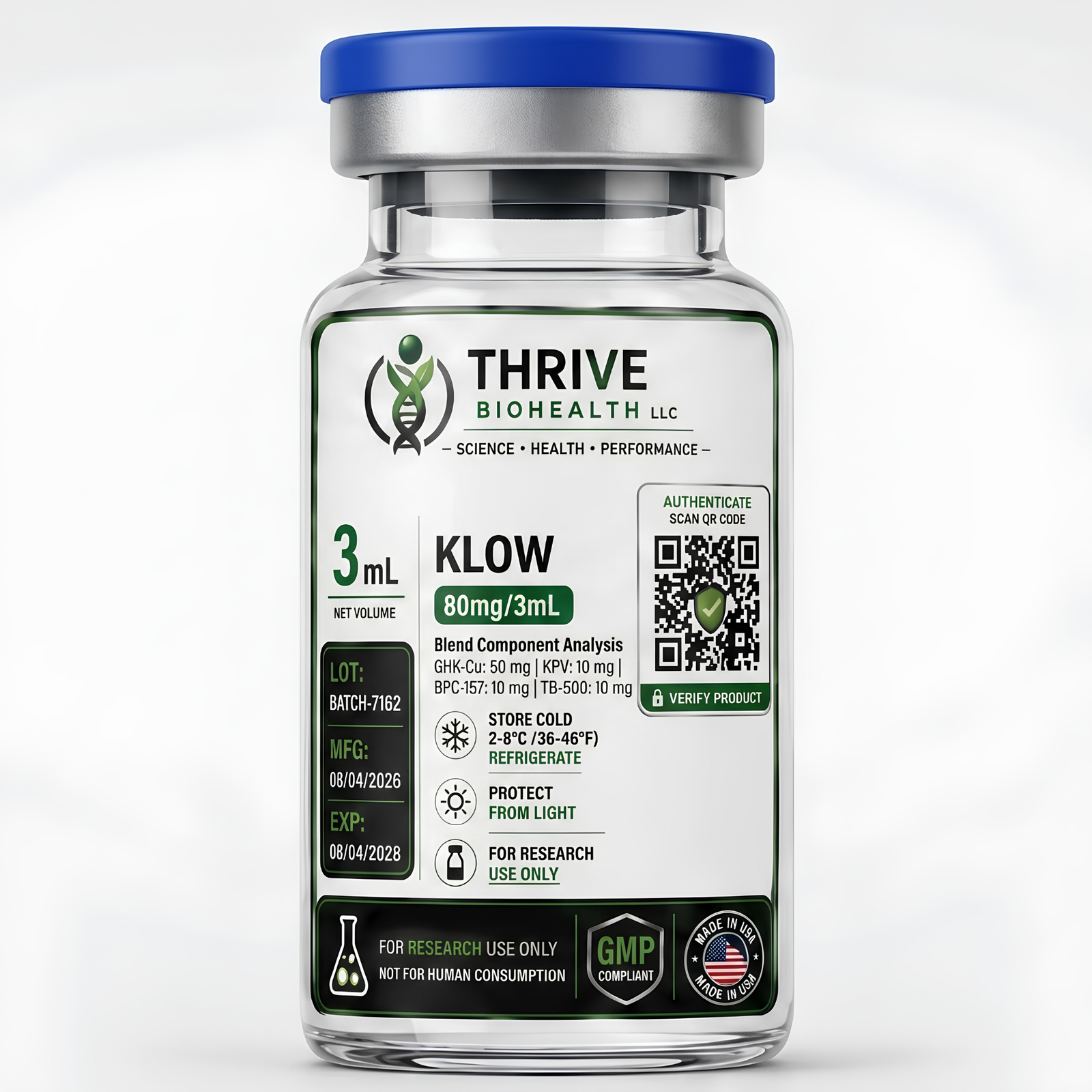
Thrive BioHealth Klow (80 mg) (GHK-Cu, TB-500, BPC-157 and KPV)
$124.99
Thrive BioHealth Klow Peptide Blend (80 mg) combines four synergistic peptides—GHK-Cu, TB-500, BPC-157, and KPV—in a single lyophilized formulation. Engineered for comprehensive research into multi-pathway tissue repair, actin cytoskeleton motility, angiogenesis, and NF-κB inflammatory resolution. Produced under cGMP conditions with >98% purity guaranteed.
100 in stock
KLOW (80 mg) (GHK-Cu, TB-500, BPC-157 and KPV)
Combines GHK-Cu, TB-500, BPC-157, and KPV to support tissue regeneration, wound healing, and inflammation reduction in research. FOR RESEARCH USE ONLY.
PRODUCT DETAILS
KLOW Peptide Blend is an 80mg multi-peptide research formulation combining four complementary peptide sequences for advanced studies in tissue regeneration, wound healing, and extracellular matrix remodeling. This blend is designed for researchers investigating the synergistic interactions between peptides that individually target different aspects of the repair cascade.
Preclinical models have utilized multi-peptide approaches to study enhanced collagen deposition, angiogenesis modulation, inflammatory cytokine regulation, and stem cell recruitment. The KLOW blend enables investigation of these overlapping pathways within a single experimental framework, reducing the complexity of multi-agent dosing protocols.
Manufactured with each component peptide individually verified by HPLC (purity >99%) and mass spectrometry before blending. Final product undergoes additional quality checks including endotoxin testing and sterility verification. Certificate of analysis available for each lot.
Store lyophilized at -20°C. Reconstituted at 2-8°C, use within 60 days. Avoid repeated freeze-thaw cycles to maintain peptide integrity.
For research and laboratory use only.
Multi-peptide blend research addresses a methodological gap: repair cascades in vivo involve overlapping signals — matrix remodeling, angiogenesis, inflammatory resolution — that single-compound studies cannot model simultaneously. Blends such as KLOW (GHK-Cu, TB-500 fragment, BPC-157, KPV) let investigators compare combined-exposure outcomes against single-peptide arms to identify additive versus redundant pathway effects.
About KLOW Peptide Blend – 80mg
KLOW Peptide Blend is an 80mg multi-peptide research preparation that brings four sequences together in a single lyophilized vial: GHK-Cu, TB-500, BPC-157 and KPV. Each is an established subject of tissue-repair literature in its own right, and each addresses a different part of the repair cascade. The blend lets investigators study all four under one exposure protocol rather than assembling and timing four separate preparations, a familiar source of variability in combination work.
GHK-Cu, the copper-bound tripeptide Gly-His-Lys, contributes the matrix arm: it is studied for copper delivery, for broad modulation of gene expression, and for a dual influence on extracellular matrix turnover, stimulating collagen and elastin synthesis while supporting controlled breakdown of disorganized matrix.
TB-500, the synthetic counterpart of thymosin beta-4, contributes cell motility through its sequestering of G-actin monomers, which governs how readily cells migrate and remodel tissue.
BPC-157, a stable pentadecapeptide fragment of a gastric protective protein, contributes angiogenic and cytoprotective signalling.
KPV, the C-terminal tripeptide of alpha-melanocyte-stimulating hormone, contributes an anti-inflammatory arm. That fourth component is what separates KLOW from a three-component repair blend. GHK-Cu, TB-500 and BPC-157 overlap considerably across matrix, migration and vascular signalling, but none of the three is primarily an inflammation-resolution agent. KPV is studied specifically for suppression of pro-inflammatory transcription, and its inclusion gives a dedicated inflammatory arm alongside the regenerative ones.
Combination designs exist because repair in living tissue is not a single pathway: inflammatory resolution, vessel formation and matrix remodelling run concurrently, and single-agent studies cannot model that concurrency.
Typical users are laboratories running comparative preclinical work: groups studying wound closure, tendon and soft-tissue repair or matrix organisation who want a combined-exposure arm to set against single-peptide arms, and groups asking whether the effects of these sequences prove additive, redundant or in tension.
Because the four peptides are co-formulated in fixed proportion, the blend behaves as one experimental variable rather than four, which simplifies protocol design while removing the ability to vary components independently.
All work with this material belongs in controlled laboratory settings and in the hands of qualified investigators. KLOW Peptide Blend is supplied for Research Use Only and is not approved for human or veterinary use.
Mechanism of Action
The mechanism of KLOW Peptide Blend is a composite of four profiles rather than one unified pathway. No constituent shares a receptor with the others, and two have no identified high-affinity receptor at all. Researchers therefore map each component onto the phase of repair its described activity fits, then ask whether combined exposure produces effects the individual arms do not.
GHK-Cu acts as a copper-carrying signalling molecule and a modulator of gene expression. Its affinity for copper is exceptionally high, and the chelated complex is the active form; through it copper reaches cells as a cofactor for enzymes such as superoxide dismutase. Transcriptomic work in cell lines shows GHK-Cu modulating a large portion of the genome, favouring repair and antioxidant genes over those of inflammation and fibrosis.
Its matrix behaviour is dual-modulatory: collagen I and III, elastin and glycosaminoglycan synthesis are stimulated through pathways such as TGF-beta and SMAD, while matrix metalloproteinases and their inhibitors are also upregulated, permitting removal of disorganized collagen rather than uncontrolled deposition.
TB-500, the synthetic form of thymosin beta-4, works at the level of the cytoskeleton. Its principal intracellular role is sequestering G-actin monomers, maintaining a mobilizable pool that governs polymerization into F-actin filaments. Because actin dynamics determine motility, this underlies migration of fibroblasts, keratinocytes and endothelial cells during re-epithelialization and angiogenesis. Extracellularly it promotes matrix metalloproteinase expression, allowing matrix degradation during remodelling, and downregulates cytokines such as TNF-alpha.
BPC-157 has no identified high-affinity receptor; its activity is attributed instead to modulation of downstream pathways. Central among them is upregulation of vascular endothelial growth factor receptor 2, whose activation initiates the FAK-paxillin and PI3K/Akt cascades. Focal adhesion kinase and paxillin are core to focal adhesions and therefore to cell adhesion and migration, while PI3K/Akt signalling phosphorylates endothelial nitric oxide synthase and raises nitric oxide production. BPC-157 appears to normalize nitric oxide in states of both over- and under-production, a role described as homeostatic rather than simply stimulatory.
KPV works through receptor-dependent and receptor-independent routes. In systems expressing melanocortin receptors, particularly MC1R and MC3R, it raises intracellular cAMP and activates protein kinase A, which inhibits the NF-kappaB cascade; stabilization of IkappaB-alpha traps NF-kappaB in the cytoplasm and prevents transcription of pro-inflammatory mediators. KPV also acts where surface receptors are absent, as internalized peptide interferes directly with intracellular signalling and with NF-kappaB binding to its DNA targets.
Mapped onto the repair cascade, these give three arms on different phases. The inflammation arm, carried by KPV, belongs to the earliest phase, where the question is how quickly and cleanly the response resolves. The angiogenesis and migration arm, carried by BPC-157 and TB-500, belongs to the proliferative phase: one supplies the vascular signalling, the other the cytoskeletal machinery motility requires. The matrix arm, carried by GHK-Cu, belongs to remodelling, where what matters is not how much collagen is laid down but how well it is organized.
Research Applications
KLOW Peptide Blend is used in preclinical work where several strands of the repair response are examined at once. The most common setting is wound healing. Full-thickness dermal wound models in rodents follow closure rate, re-epithelialization and the quality of granulation tissue, while in vitro scratch and migration assays in fibroblast and keratinocyte cultures isolate the cell-movement component. A four-component preparation is of interest here because closure depends on inflammatory resolution, vessel ingrowth and matrix deposition together.
Tendon and soft-tissue repair form a second major application. Animal models of tendon, ligament and muscle injury are used to assess collagen fibre organisation by histology, fibroblast proliferation, and mechanical properties such as tensile strength in repaired tissue. BPC-157 and TB-500 have been studied as a pair in this setting for some time, and the blend extends that pairing with a copper-peptide matrix component and an anti-inflammatory one, so investigators can ask whether the additions change the structural outcome or only the inflammatory profile around it.
Angiogenesis is studied both as an endpoint and as an intermediate variable. Endothelial cell cultures, including human umbilical vein endothelial cell systems, measure migration, proliferation and tube formation, while in vivo work quantifies neovascular density within granulation tissue. Because BPC-157 is associated with pro-angiogenic signalling and TB-500 with the actin dynamics endothelial migration depends on, the blend tests whether signalling and structural support together give vessel formation distinguishable from either alone.
Extracellular matrix remodelling is a distinct line of investigation. Studies here look at collagen type I and III ratios, elastin and glycosaminoglycan content, metalloproteinase and tissue inhibitor activity, and the organisation rather than the bulk of deposited matrix. GHK-Cu is the component of primary interest, and its dual effect on deposition and degradation suits models that distinguish organized repair from fibrotic scarring.
Inflammatory cytokine regulation runs through all of the above and is also studied directly, by measuring mediators such as TNF-alpha, IL-6 and IL-1 beta in tissue and culture supernatant alongside the NF-kappaB signalling that governs their transcription. KPV in particular has been studied extensively in mucosal and gut-inflammation models, including chemically induced colitis in rodents, where histological damage, inflammatory cell infiltration and mucosal cytokine expression are the standard endpoints, and in models of inflammatory skin conditions.
The broader value of the preparation is methodological. Single-agent studies cannot show whether pathway effects are additive, redundant or antagonistic, because they never present the pathways at once. A fixed-ratio blend gives a combined-exposure arm to compare against single-peptide arms within one framework.
These applications are confined to laboratory settings. This product is for Research Use Only and is not for human or veterinary use.
Formulation Handling
For Research Use Only. KLOW Peptide Blend is supplied as a lyophilized powder, the form in which the four constituent peptides are most stable. Store the unreconstituted vial at -20°C for long-term storage; refrigeration at 2-8°C is acceptable for periods of several weeks. Protect the vial from direct light.
Allow a frozen vial to equilibrate to room temperature before opening, so that condensation does not settle on the powder. Reconstitution should be carried out using aseptic technique in a controlled laboratory environment.
Sterile bacteriostatic water containing 0.9% benzyl alcohol is the usual diluent, as it helps maintain sterility across repeated withdrawals. Introduce the diluent slowly, directing the stream down the inner wall of the vial rather than onto the powder itself, then swirl or roll the vial gently until the contents dissolve.
Do not shake or agitate vigorously; foaming and mechanical stress degrade peptides. The reconstituted solution should be clear and free of visible particulates.
Store it at 2-8°C, and for work spanning longer periods divide the freshly reconstituted material into single-use aliquots so that repeated freeze-thaw cycles are avoided.
One point is specific to this preparation. Because KLOW is a multi-component blend, the four peptides are co-lyophilized in the vial and the whole vial reconstitutes together in fixed proportion. The constituents cannot be separated or prepared independently from the reconstituted solution, so studies requiring individual components at independent concentrations should use the single peptides rather than the blend.
Quality Standards
Thrive Biohealth LLC supplies KLOW Peptide Blend to the same analytical standard applied to our single-peptide products. Each constituent peptide is synthesized in a facility operating in compliance with current Good Manufacturing Practices, under documented manufacturing and testing controls, before the components are combined into the finished blend.
Lot traceability is maintained throughout, so that any vial can be tracked back to its manufacturing and testing records.
Purity is verified by High-Performance Liquid Chromatography, with each peptide component confirmed at >99% purity. Identity is confirmed separately by Mass Spectrometry, which verifies that the measured molecular weight of each constituent matches the theoretical mass of its sequence.
Because this is a blend rather than a single compound, both analyses are performed per component, covering GHK-Cu, TB-500, BPC-157 and KPV individually rather than reporting one aggregate figure.
Every lot is also tested for endotoxin, which matters particularly for material used in inflammation and repair research, where residual endotoxin would confound the very readouts under study.
A lot-specific Certificate of Analysis is available for every batch. For a multi-component preparation the certificate reports the identity and purity of each constituent peptide together with the stated ratio in which they are combined, giving investigators the composition of the exact material in hand rather than a nominal formulation.
This documentation supports reproducibility across experimental series and allows results to be tied to a specific lot.
This product is for Research Use Only and is not for human or veterinary use.
View Certificate of Analysis →
For Research Use Only (RUO). Not for human consumption, veterinary use, diagnostic use, or therapeutic purposes. All products are intended for in vitro research in licensed laboratory environments only.
| Presentation | Lyophilized Vial |
|---|---|
| Strength | 80 mg |
| Brand | Thrive BioHealth |
Related products
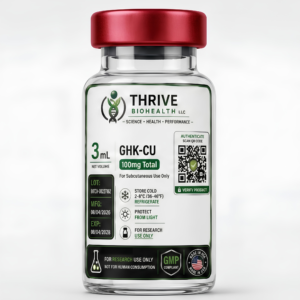
Thrive BioHealth GHK-Cu (100 mg)
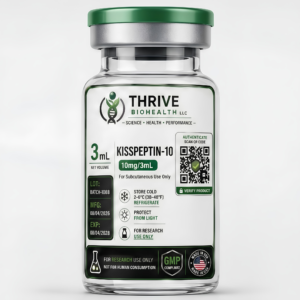
Thrive BioHealth Kispeptin (10 mg)
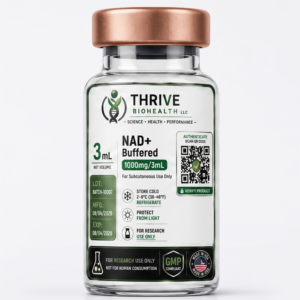
Thrive BioHealth NAD+ (1,000 mg)
Reviews
There are no reviews yet.